
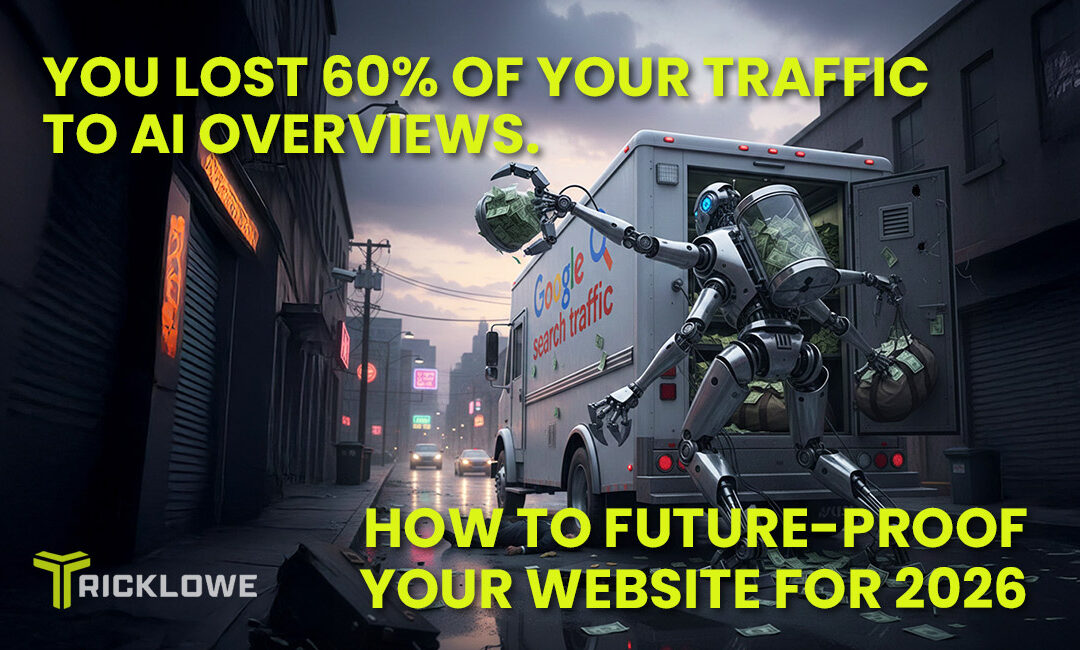
AI Overviews and LLMs like ChatGPT, Claude, Perplexity, and Google Gemini, have completely destroyed and changed internet search, almost overnight. So, if you thought recently your website has lost a lot of traffic, or that you’re not getting as many enquiries through your website, you’re not crazy at all.
You’re absolutely right. Everything has changed, and you need to get on top of it.
There’s been a complete cultural shift in internet search happening right now, affecting almost every website in the world.
Hundreds of millions of websites have lost MASSIVE amounts of search traffic over the past 3 years.
And, with the most recent Google core updates in September 2025, and December 2025, even MORE search traffic has beneffen lost.
Search impressions and click-through rates (CTR) have dropped through the floor, almost overnight.
It’s as if someone all of a sudden switched off all the search traffic coming from Google.
And, as usual, it’s Google that made that change.
Massive Drops in Search Traffic Have Affected All Websites
Out of the 1.3-1.4 billion websites in the world today, around 200 million websites in the world are updated and maintained.
Approximately 150 to 250 million websites have been affected by MASSIVE drops in search impressions and click-through rates (CTR) recently.
Yes, you read that correctly.
This recent shift in internet search behavior, has affected more than just the sites that are regularly maintained.
It’s affecting every single website.
Even those websites that were getting regular search traffic for years, had great marketing, produced leads, and collected passive income, are losing traffic faster than ever before.
Studies now show that 75-90% of websites relying on organic search traffic, have experienced massive declines.
Even some of the biggest websites in the world today, have been affected in a really big way.
Major Websites That Have Lost Search Traffic from Google
- HubSpot: 80% drop in website traffic
- CNN: 27-38% drop in website traffic
- Forbes: 50% drop in website traffic
- 37 out of the 50 major U.S. news websites have ALL seen declines in search traffic.
Widespread Website Search Traffic Reductions
Reports from Bain & Company and Gartner shows an average organic traffic loss of around 15-25% across all websites.
Publisher-Specific Website Impacts in Search Traffic:
Chartbeat took data from over 2,500 global publisher sites, and showed a 33% decline in Google search referrals in 2025.
Not Sure if Your Site is Affected?
Get a free 30-minute traffic analysis. We'll show you exactly where your traffic went and which competitors are gaining ground.
What Caused Websites to Lose So Much Traffic in 2023-2026?
You might be thinking that everyone just switched to using AI now. Only that’s not the right answer at all.
Currently, only 5% of searchers are using LLMs like ChatGPT, Gemini, Claude, Perplexity or Grok, for search.
So yes, some users ARE starting to use LLMs for search, but not very many.
People also use LLMs in a very different way to how they use Google.
People Use AI & LLMs to Search in a Different Way
AI searches are mostly top-of-funnel searches. These types of searches are made when people still deep in the research phase, with almost ZERO intention to buy just yet.
Internet users are also using LLMs like ChatGPT as consultants, advisors, editors, and deep-diving into topics.
So, people are not using ChatGPT to buy things.
They’re using LLM’s to find answers.
People Still Use Google to Buy Products & Services
When it comes to the moment people are ready to buy products and services, Google is still king.
Today, Google still handle over 90% of all internet search traffic.
Google is still where everybody goes once they’ve done their research, and they’re ready to buy.
So, Google still has a massive stronghold on internet search with buyer intent.
Only, none of this explains what happened to all the search traffic.
So, if the sudden drop off in all website’s impressions, CTRs, and organic search traffic, isn’t because of a mass exodus to ChatGPT, then what caused it?
It’s because Google introduced the AI overview, or ‘AIO’.
What Changed: Google AI Overview Launched in 2023
In September 2023, Google introduced a new feature called the ‘AI Overview’ or ‘AIO’.
For the first time ever, Google would no longer present users with a list of recommended websites to choose from, to do their own research.
Instead, the Google AI Overview now automatically generates an answer to your informational searches, using AI.
AI generates the answers to your questions from the information on the websites it gathered the information from.
So, Google’s AIO works in a very similar way to an LLM like ChatGPT, Claude, Perplexity, etc.
Only, the Google AI overviews uses up-to-date information available on websites, and in it’s crawl data,
A key important fact here (more about this later), is that the Google AIO still uses website citations to research and generate the answer to questions.
The difference is, the answers are more in-depth, and provide context in the answer.
This saves us a TON of time.
In fact, most of the time people don’t even go to websites anymore.
So, understanding how to optimize for AI Overview citations is not just something you might need to do, it’s essential for survival.
Zero-Click Searches are Taking Over Google
We no longer need to dive into websites, research, and take notes, because AI Overviews do all that for us in a matter of seconds.
If we’re researching a product, we no longer need to deal with weeding through 10 websites.
Google’s AIO provides such a good answer to your question, you no longer need to visit a website at all.
We’ve now entered the era of the ‘no-click search’.
As of today, the vast majority of informational searches on Google, are providing answers generated by Google AIOs, and mostly end in a no-click search.
So, this is where all your website traffic has gone.
Click-Through Rate (CTR) Drops are Caused by No-Click Searches
When AI overviews appear, CTR (Click Through Rates) fall 34-61% for organic search results.
This is the same for Paid traffic, too.
Up to 68% for paid search traffic, per studies from Pew Research, Seer Interactive, and Semrush.
Even without AIOs, organic CTR is down 41% year-over-year.
More Evidence of AIOs Killing Click-Through Rates
According to Pew Research Center, when an AI Overview appears in search results, only 8% of users now click through to a traditional website link.
Yes, you read that correctly; 92% of search sessions do not send traffic back to a website.
73% of B2B websites reported significant organic traffic losses between 2024 and 2025, directly linked to the rise of zero-click search and AI Overviews.
This implies that most content-dependent business sites (not just a tiny minority) are losing meaningful traffic.
Citation: https://abmagency.com/what-is-zero-click-search-and-how-has-it-impacted-b2b-marketing/
Industries Affected by Drops in Click Through Rates from Google
The retail industry, news, entertainment, travel, and marketing agencies report 20-50% traffic at risk, with 80% of consumers relying on AI summaries for at least 40% of searches.
Google Denies Any Drops in CTR
Even with all this data and proof, Google claims that average regular click volume is stable.
Although independent research and analysis from Digital Content Next [ADD LINK] have shown 10%+ declines, which also applies to tens of millions of smaller sites.
Search traffic from Google HAS taken a massive nosedive.
My thoughts on Google denying the drop in CTRs?
It’s a weird moment in history, it’s kinda not a good look for Google, but they still want to keep doing what they’re doing.
Google ARE still using your websites and knowledge to provide answers to questions, but the websites get none of the rewards at all.
To make it worse, this isn’t going away any time soon.
This is a permanent shift in how the internet works.
Today, around 60% of Google searches provide AI summaries.
There are projections for a further 25% overall drop in search-driven traffic to ALL websites by the end of 2026.
The AI Overview Recovery Checklist
Get our step-by-step checklist showing exactly which pages to optimize first, what content structure AI prefers, and how to track your citation rate across platforms.
Fewer Leads Are Being Generated From Organic Search
The increase in no-click searches has led to fewer leads for millions of websites, and has lost tons of revenue for many businesses.
This has crippled growth for many websites and businesses, because it greatly increases the cost of lead generation.
This will further compound as competitors resort to the same strategies.
Paid Ads Costs Will Increase & Compound Faster Than Ever
The cost of paid ads have increased continuously for decades.
When more companies turn to using paid ads (even as a short-term strategy), the cost of ads will eventually get to a point of cost ineficiency.
What Happens if You Don’t Change Your SEO Strategies?
Waiting for something to change that’s out of your control is like sitting there waiting for your own death to come.
Those that adapt while millions of websites simply get left behind, will simply own the next decade, and take it all away from you.
Your website will lose all it’s traffic, while the Google AIO answers your prospects’ questions using your knowledge… without ever sending them to you.
Read that again.
The ‘middle-man’ stopped being a pass-through, and became you.
Google is now the informational resource.
Your Brand Will Disappear from the Customer’s Research Journey
If you don’t change your SEO strategy now… your competitors that do change strategy will become the only names AI recommends.
The result of this is, is your brand quietly stops showing up when buyers are ready to buy.
If you fail to adapt, your business will face a permanent collapse of it’s ‘discovery engine’.
AI will continue to grow, and capture 60-70% of search queries, long before anyone ever gets to see your website.
The end result is your business becomes invisible at the most critical point… …the customer’s research phase.
That leaves the next decade of market share to competitors who successfully positioned themselves as AI’s recommended authority.
But Here's the Massive Opportunity Nobody's Talking About
While everyone's panicking about traffic loss, there's a gold rush happening that most businesses are completely missing.
Early movers in AI optimization are seeing:
- 40-60% increases in qualified leads (even with less traffic)
- Higher conversion rates (AI pre-qualifies prospects)
- Reduced customer acquisition costs
- Brand authority across multiple AI platforms
Why?
Because when AI cites YOU as the answer, you're not competing with 10 other websites anymore. You're THE recommended authority.
Think about it: When ChatGPT, Perplexity, or Google's AI Overview recommends your business to someone ready to buy, that's worth 100x more than being link #7 on page one.
The companies adapting right now are positioning themselves as THE authority for the next decade. While competitors lose traffic and panic, they're being cited, recommended, and chosen.
This is the biggest shift in marketing since Google launched in 1997. Those who move first won't just survive, they'll dominate.
So, now it's our move.
Here's what we need to do about it.
Google is Not a Search Engine Anymore
We need to stop thinking of Google as a search engine.
Today, we need to think of Google as an AI powered research assistant.
Google is now capable of supplying anyone with the research and notes on any informational search topic. This saves us time by diving into websites, and providing the compiled research along with citations, almost instantly.
Many website owners are angry at this, because they feel like Google is ‘taking their content without reciprocating’.
Only, let’s take a step back for a moment, before jumping on that bandwagon.
Google is a free and open marketplace, with the same goal it’s always had since day one.
These websites were making money from a cash cow, because the website goals were aligned with Google’s number one goal.
Let’s remember what Google’s number one goal is right now… because that hasn’t changed, and it never will.
Google’s number one goal is also the same goal as every LLM, and AI, and any future search platform.
What is Google’s Number One Goal?
Google’s number one goal is to ‘provide the user with the most RELEVANT answer to the question, as quickly as possible.’
The only reason people use Google, is because they’re the best at doing this. And, this goal is NEVER going to change.
If Google were to stop being the best resource, users would go somewhere else. If that happened, Google would be out of business in less than a week.
So, every algorithm change since Google first launched in 1997, has been to correct, or improve their results.
This recent shift has a lot of people REALLY confused, and others pulling out their hair.
The good news is; this doesn’t limit us to just Google anymore. We can now optimize to rank for citations on ALL AI platforms.
If you want to be the answer AI gives, you just need to write your content a little differently.
Here's exactly how…
How Your SEO Strategy Needs to Change for AI Overview
The biggest shift that needs to happen in your SEO strategy, is content no longer needs to be written for humans to read directly.
Your content still needs to be readable, useful, and valuable to humans when read. But, it needs to be written and structured in a way that’s also easily scanned and cited by AIOs and LLMs, as an informational resource.
We’re writing content for AI assistants (AKA answer engines) now, not search engines.
So, this is no longer SEO (Search Engine Optimization), it’s AEO (Answer Engine Optimization), which needs to be structured differently.
Great content written with AIO and AEO in mind, answers questions much closer to the bottom of the funnel.
Think about this as answering the last couple questions your ideal prospect asks, right before buying from you.
AI Optimized Content Needs to be Much More Strategic
So, is AEO and AIO Optimization Just Strategic SEO?
AEO and AIO Optimization DOES **have a lot of similarities to Strategic SEO, but it’s not exactly the same.
Strategic SEO is a type of content marketing, that does target the prospect much closer to the moment of buying.
There are subtle differences that must be paid attention to.
Differences Between Strategic SEO and AEO / AIO Optimization
Here are the main differences in strategy for strategic SEO and AI optimization.
Strategic SEO
- Strategic SEO is designed to be read by a human to assist them make a buying decision.
- Potential customers may read Strategic SEO content, and disqualify themselves as a buyer. This helps your ICP (Ideal Client Profile) to find you, and filter out the people that your product is not ideal for.
- Web pages implementing strategic SEO strategies often offer an incentive for an ideal customer to give out their personal information. For example, to download a lead magnet (raising a hand as a prospect), or fill out a lead form (lead generation).
AEO & AI Optimization Strategy
- AIO content is written and structured to be easily scanned and summarized by AI.
- Strategic AI content is written to gain citations from AI engines, not to be read by humans directly.
- Your articles and blog posts must be structured content, making it easy for AI to quote things like statistics.
- When producing content structured for AIO / AEO, you’re literally writing to answer the questions, not explain complex problems in detail
- Summaries, lists, bullet points, charts, timelines, and FAQ’s are extremely important in AEO / AIO optimization
AEO / AIO optimized content is not written to be read by humans (but still makes perfect sense, when read). It’s written to provide a human with an answer, generated by the machine, quoting your content.
Writing for AI as Like Writing Notes for Someone Else’s Speech
If you were making a speech or a presentation, you’d either have a teleprompter with script, or bullet points and cliff notes from which you grab your main points, and adlib the rest.
Think of writing for AI is if you’re writing notes for a speech, that SOMEONE ELSE is going to deliver.
Writing for AI is like writing a speech for someone else that knows NOTHING about your topic… …but knows how to:
- Speak really well in front of people, think on the fly, and present the main idea in 2-3 minutes.
- Pull out very specific details in the context of the question being asked, like a Q&A session.
- Can combine your topic with info from other experts, and deliver a quick synopsis of those opinions, with citations. Think of this like hosting the oscars, or introducing guest speakers.
AI Engines, AEO, and AI Overviews, are similar to:
- An afternoon kids TV presenter that speaks between shows, interviews guests, and makes people laugh.
- A morning show TV host that flips between interviews, guests, the weather, the news, social commentary, current affairs, politics, hobbies, trends, and other shows being aired.
- Google, only it doesn’t send you to a search engine, or a web page, it gives you the answers you need, and options to dig in deeper.
Well Written AI Content Can Better Deliver Omnipresence
Good AI content will give your brand omnipresence across many platforms.
If you’re cited on one AI platform with an original piece of content, it’s likely you will rank on other platforms, too.
Google still has search market dominance, but for how long?
Write for the future, where you can be quoted by many.
Geographic SEO is Much More Important in AI
Geographic SEO is writing content targeting specific areas, cities, regions, states, or countries.
This is nothing new to any Local SEO expert, where hyper-local content helps your Google Business Profile rank higher in your city. Which, is still the absolute best way to get leads for a local business, and is not affected at all by AI yet.
Side Note: If you have a local business, and are currently NOT ranked in the top 3 results on Google Maps search results in your city, we need to talk.
Having content on your website that specifically talks about the region you serve, or how your product ranks in that country, or awards you won ‘in X place’, really help with AI citations and recommendations.
Summary of Effective AIO Optimization and AEO Strategies
Here are the strategies that are currently most effective at getting cited and recommended by AI:
1. Create Scannable, Citation-Ready Content
- Use clear H2/H3 headers that answer specific questions
- Include statistics in standalone sentences (not buried in paragraphs)
- Add FAQ sections at the end of each article
- Structure data in tables, lists, and bullet points
- Example: Instead of writing "Our clients have seen good results," write "73% of our clients recovered their traffic within 90 days.
2. Optimize Video Content for AI Discovery
- Upload to YouTube with detailed, keyword-rich descriptions
- Include timestamped chapters in video descriptions
- Add accurate closed captions (auto-captions aren't enough)
- Embed videos on your website with text summaries above/below
- Create short-form clips for social platforms with citations back to your site
3. Publish Comprehensive PDF Resources
- Create in-depth guides (15-30 pages minimum)
- Use clear chapter structure with page numbers
- Include data tables, charts, and visual summaries
- Make them freely downloadable (no email gate for AI access)
- Submit to document-sharing platforms (SlideShare, Scribd)
4. Write Original, Data-Driven Listicles
- Go beyond generic "Top 10" lists with unique angles or recent data
- Include specific statistics, dates, and sources for each point
- Add a summary section at the top (AI pulls from these)
- Use consistent formatting: clear headers, short paragraphs, bullet points
- Example: Instead of "Best Project Management Tools 2026," write "How 500 Construction Companies Ranked Project Management Software: Data-Backed Results"
- Always cite your sources and methodology (builds citation credibility)
5. Create Comprehensive Free Educational Resources
- Develop in-depth guides, courses, or frameworks (not surface-level content)
- Include a detailed summary or overview page that AI can easily parse
- Break content into clear modules or chapters with descriptive titles
- Add downloadable resources (checklists, templates, worksheets)
- Make key takeaways and statistics easily extractable
- Example structure: Overview page → Individual lesson pages → Summary/conclusion → Downloadable resources
- Remember: You're now optimizing for AI to recommend your resource to users, not just for users to find it themselves
6. Build Authority on AI-Monitored Social Platforms
- Post detailed, helpful answers on Reddit in relevant subreddits
- Share insights on LinkedIn with data and specific examples
- Contribute to industry forums and Q&A platforms
- Include links back to your comprehensive content (not promotional)
- Use consistent expertise markers (credentials, company, experience)
- Example: Answer questions thoroughly with "I've worked with 50+ companies on this issue, here's what actually works..." then link to your detailed guide
- AI platforms particularly value Reddit, Quora, and LinkedIn for sourcing expert opinions
So, the whole online world has shifted, and you might be getting left behind.
You have a ton of blog content, but you just lost all your site traffic.
Or maybe you’re just starting out, literally just learned how to write content, and now THIS just happened.
It could even be, that you’re working with an agency.
Perhaps they either don’t know what they’re doing, or the only answer they have, for you, is to start using paid ads.
Frequently Asked Questions About AI Overview & Traffic Loss
What is Google AI Overview and when did it launch?
Google AI Overview (AIO) is a feature that automatically generates AI-powered answers to search queries, displaying them at the top of search results.
It launched in September 2023 and has since expanded to cover approximately 60% of all Google searches. Instead of showing a list of websites, Google now provides a complete answer using information gathered from multiple sources, significantly reducing the need for users to click through to websites.
What is a zero-click search?
A zero-click search is when a user gets their answer directly from the search results page without clicking through to any website.
According to Pew Research Center, when an AI Overview appears, only 8% of users click through to a traditional website link, meaning 92% of search sessions end without sending any traffic to websites.
How much traffic are websites actually losing to AI Overviews?
Studies show that 75-90% of websites relying on organic search traffic have experienced massive declines.
When AI Overviews appear, click-through rates (CTR) drop 34-61% for organic results and up to 68% for paid search.
Major websites like HubSpot have seen 80% drops in traffic, while 73% of B2B websites reported significant losses between 2024 and 2025.
There are projections for a further 25% overall drop in search-driven traffic to all websites by the end of 2026.
What is AEO (Answer Engine Optimization)?
AEO (Answer Engine Optimization) is the practice of optimizing your content to be cited and recommended by AI platforms like Google AI Overview, ChatGPT, Claude, and Perplexity.
Unlike traditional SEO which optimizes for search engine rankings, AEO focuses on structuring content so AI can easily scan, extract, and cite your information as the authoritative answer to user questions.
How is AEO different from traditional SEO?
Traditional SEO aims to rank your website highly so users click through and read your content.
AEO optimizes for AI to cite your content without users necessarily visiting your site.
AEO requires scannable structures like FAQ sections, standalone statistics, clear headers, bullet points, and data tables.
The content is written to be easily parsed by AI rather than to be read directly by humans, though it must still make sense when read.
Can I still rank on Google with AI Overviews active?
Yes, but the strategy has changed. Instead of ranking to get clicks, you now need to rank to get cited by the AI Overview itself.
When AI cites you as a source, you become the recommended authority.
This is actually more valuable than being link #7 on page one because AI pre-qualifies the prospect and positions you as THE expert, not just one option among many.
Is the shift to AI search permanent or will it go away?
This is a permanent shift in how the internet works. Google will not stop using AI Overviews, and with 60% of searches already providing AI summaries, the trend is only accelerating.
Every major search platform and LLM is moving in this direction.
Just like when Google first launched in 1997 and changed marketing forever, this represents a fundamental and irreversible change in how people find and consume information online.
Which AI platforms should I optimize for besides Google?
The good news is that optimizing for AI citations isn't limited to just Google.
You can rank for citations on ChatGPT, Claude, Perplexity, Google Gemini, and other emerging AI platforms.
If you're cited on one platform with original, well-structured content, you're likely to be cited on others too.
This gives your brand omnipresence across multiple platforms, future-proofing your visibility as search continues to evolve.
Still have questions about how AI Overviews are affecting your specific business?
Book a free 30-minute audit and get answers tailored to your situation.
Get a Free AI Optimization Audit (Value: $500)
In 30 minutes, I'll show you...
- Exactly which AI platforms should be citing you (but aren't)
- The 3 highest-impact pages to optimize first
- Which competitors are winning AI citations in your space
- A 90-day roadmap to recover (and exceed) your lost traffic
No pitch. No pressure. Just a clear Assessment.
Shoot Me Your Details
If any of these things apply to you, we should jump on a call.
Let’s talk AI Overview strategy and how you fix this, or put together a plan to move forwards into this next ten years, and grab some market share.